Saturday, 3 March 2012

Gerhard Richter: October 18, 1977(1988) - Alte Nationalgalerie, Berlin

As well as those who had turned out to flaunt their wares at the film festival, another name hot on people's lips when I was in Berlin was Gerhard Richter whose retrospective show "Panorama", staged to commemorate his eightieth birthday, opened at the Neue Nationalgalerie that week. It's the same one that finished recently at Tate Modern in London and, I believe, is moving on next to The Pompidou in Paris for the summer months. I'm quite a fan but had been unable to get down to London for it so was very pleased to spot it listed in Zitty magazine, deciding to go along and have a neb - as had half the city by the looks of the queues at the kiosk and the people milling around with carrier bags containing the catalogue. 

I had quite high expectations as I waited to pay my eight euros to get in but, when I left an hour or so later, I felt rather disappointed with what I had seen, this partly being down to the crowds but also to the show itself. Over the years, I think I've probably been a bit spoilt by seeing more concentrated groupings of his work, smaller in number but more focussed in certain periods or genres, at places like The Lenbachhaus in Munich, The Museum-Ludwig in Cologne and, a few summers ago, at The National Portrait Gallery in London, and for this reason the panoramic nature of the Berlin show, as belied by its title, failed to click with me really. Richter's is a large and varied output compared to a lot of other artists and "Panorama", I suppose understandably, offers a flavour of this multi-facetedness, providing various smatterings rather than anything much to get your teeth into - early pop inspired works; the smudgy black and white works from the sixties which were seemingly directly replicated from photographs and postcards in order to solve the problem of having to find a subject matter; the large, often multi-coloured abstracts, the production of which has often involved dragging the paint around with a squeegee and which can sometimes look like the works of a less controlled Bridget Riley; sculptures made out of glass and mirrors,  which I must admit to almost walking past as though they were part of the furniture; endless paintings consisting of charts of little squares of colour; and the hyper-realistic, almost photographic paintings from the eighties and nineties such as the oft replicated "Betty"(1988) and the candle which appeared on Sonic Youth's cover for "Daydream Nation". I don't want to sound too critical of this exhibition. There was something there to please everybody, I guess, but I came away a little bit bored, feeling as though someone who can ordinarily arrest my attention had been presented in a rather anodyne, highly palatable manner, geared towards mass consumption for the polymathic, newspaper devouring classes and sales at the gift shop, which as mentioned appeared to be doing a roaring trade. 

To counteract my slight dejection, I was delighted, therefore, to find out that his cycle of paintings "October 18, 1977" was showing across town at The Alte Nationalgalerie on Museum Island, these being amongst my favourite works by any artist ever and, ordinarily housed at MOMA in New York, usually feeling a little too out of reach, except for books and the internet.
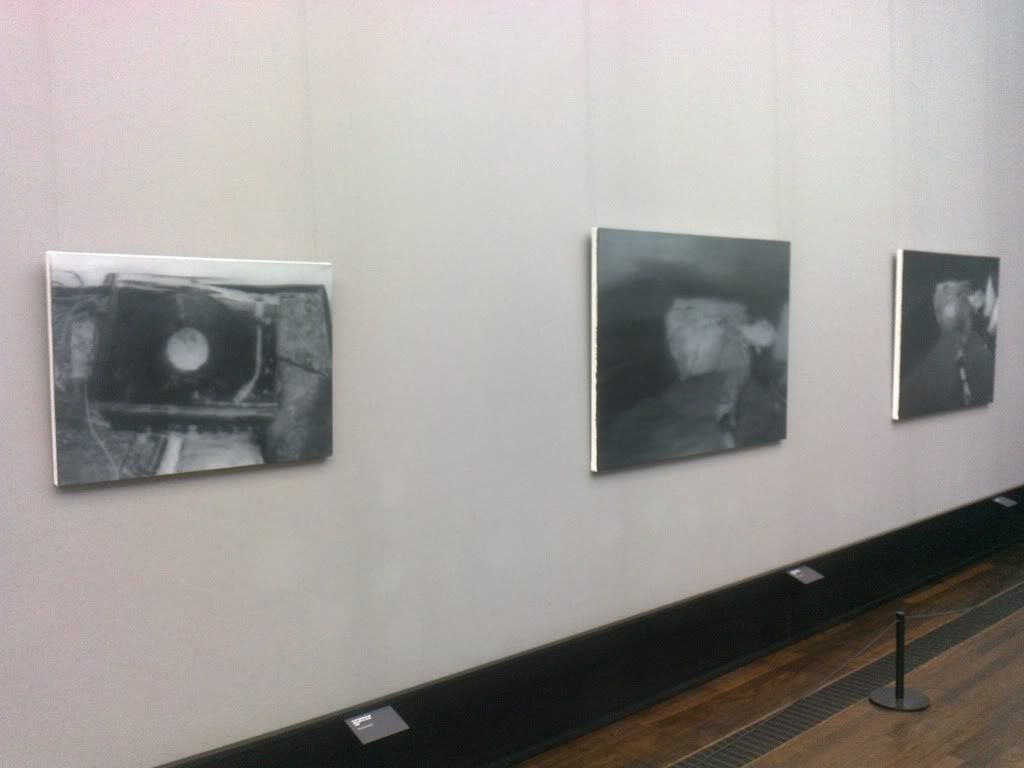

For anyone not familiar with them, the fifteen canvases, painted just over a decade after the occurence of the events that provide their subject matter, concern themselves with events surrounding the morning on which Red Army Faction members Andreas Baader and Gudrun Ensslin were found dead in their prison cells at Stammheim Prison, Stuttgart, and two further members, Jan-Carl Raspe and Irmgard Moeller, were also found dying or injured in their rooms, this having been explained by the authorities as a kind of suicide pact, although anyone reading around the events will see that many people believe that they were, in fact, murdered by the state they had dared to confront.

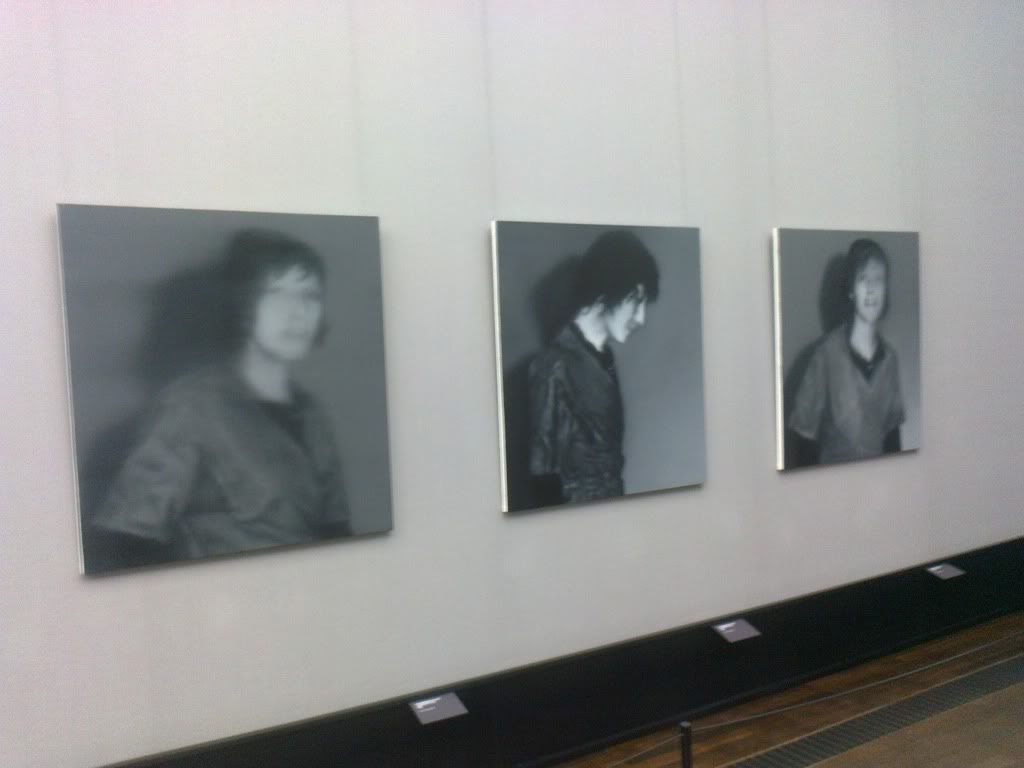
They're an extremely interesting group of paitings, in my view, not least because, like his work from the mid-sixties, which Richter seemed to have left behind by this point, they are copied from existing images, these related to the morning in question and events surrounding it, some of which would have been taken in the cells by prison staff and most of which, if not all, the German public will have been familair with through their appearance in the media. They also fall into interesting sub-groupings, with some of the canvases, in some cases practically reproductions of partners or in others more individual elements, forming clusters attached to different particpants in the drama. So, along one wall, there is a kind of triptych of portraits of Gudrun Ensslin, entitled "Confrontation 1" through to "Confrontation 3", cropped from photographs taken of her as she went to attend an identity parade at Essen Prison shortly after her arrest in 1972. She then appears again in a solo image, this one much more blurry and almost abstract on a first glance, as she was found hanging from the bars of her cell window.
AlteNationalgalerieBerlin150211-2.jpg

Another group of three almost identical images, all called "Dead", take as their subject matter the head and shoulders of Ulrike Meinhof, as she had been cut down by prison staff a year or so earlier, the rope which brought about her demise still being visible round her neck. As with many of the other images, Richter has done away with any extraneous detail and has focussed in unequivocably on his subject matter for maximum impact. Another image of Meinhof, entitled "Youth Portrait" and based on what looks like a school or college portrait, sits on its own near one of the entrances to the space in which the paintings are exhibited. Similar to Meinhof, Andreas Baader is depicted in two almost identical canvases, "Man Shot Down 1" and "Man Shot Down 2", these showing him lying dead on the floor, having shot himself in the head, a dark shadow around his head presumably being the escaped blood. Two accompanying images, "Cell" and "Record Player" give a silent record of how he passed his time incarcerated in Stammheim and the room in which he died. The latter would definitely appear in my very top paintings were I ever asked to draw up a list. Apparently, as well as providing entertainment, the record player also allegedly provided a hiding place for the gun used in bringing about his death. The final, less intimate and almost almost indistinguishable images depict outdoor scenes, two showing Holger Meins being arrested and made to undress in front of an armoured military vehicle and another equally blurred scene showing the massively attended funeral of those mentioned above, footage of which appears in the Fassbinder related film "Germany in Autumn".
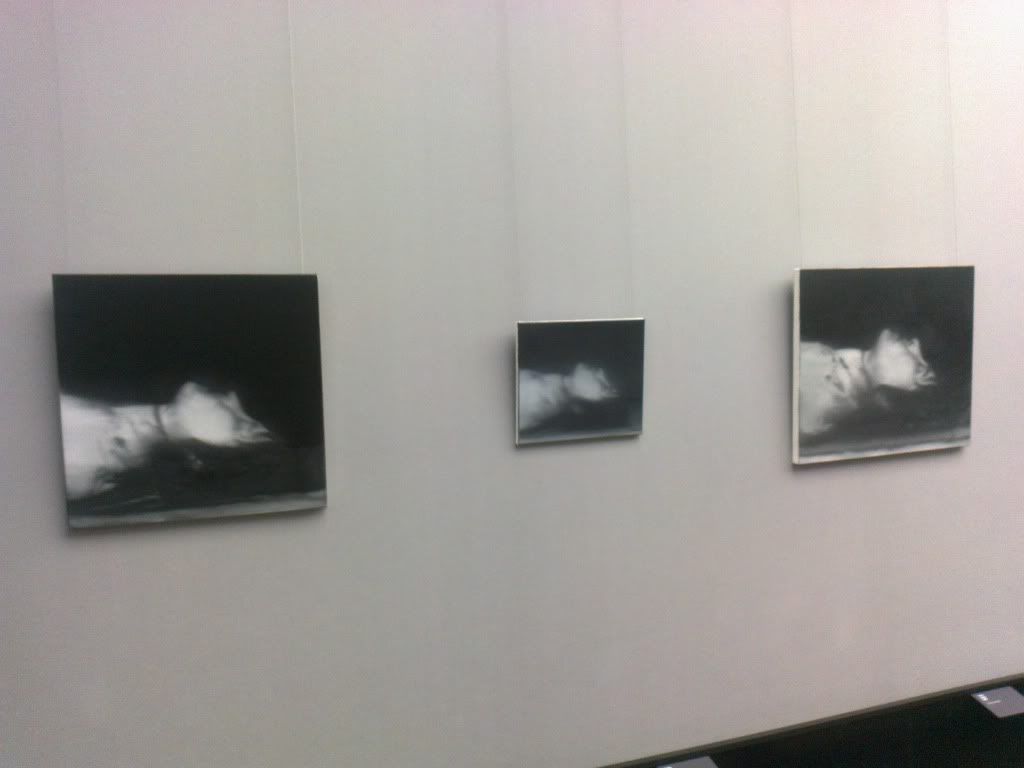

Another aspect which proves both fascinating and appealing about these paintings is their ambiguity, as they seemingly refuse to comment one way or another on what they depict, the individuals and associated scenes appearing objectively and unsentimentally as faded, blurred ghosts from German history, the already familiar nature of most of the images further adding to their confused purpose. The feathery lack of clarity in their presentation also raises unanswered questions, too, with regard to Richter's intentions. Is it a comment on the lack of certainty regarding the perpetrators of the deaths, something which will presumably never truly be known but will remain contested, or maybe a manifestation of the lack of commonality and certainty in people's attitudes towards The Red Army Faction, their intentions and actions? Also, why are some images more blurred than others?

As far as I know, Richter has never commented on his intentions but the paintings seem to have a lot in common with other earlier works such as "Uncle Rudi"(1965) which factually, but similarly blurredly, reproduces  a full-length photograph of a presumably beloved relative in Nazi uniform, "Aunt Marianne" which reproduces a family snapshot of a relative who was murdered as part of the Nazi's eugenics programme or paintings from the same period of allied and German bombers, which re-present unsettling, almost taboo aspects of national history back to the viewer whilst refusing to overtly comment. A group of smudgy, simplistic yearbook portraits of student nurses who were murdered in their dormitory, also from the sixties, seems to do a similar job and draw parallels with some of Warhol's grittier works such as his race riots, electric chairs and car accidents. In this respect, too, the exhibition's placing, in a space within the old national gallery usually populated with scenes of national heroism, packs a similar ambiguous and ironic punch.

This exhibition runs, I believe, until May and comes very highly recommended. I walked round and round in a small circle for quite a while breathing it all in and then felt quite odd as I drew myself away to have a quick look round other highlights of the gallery ( Arnold Boecklin, Lovis Corinth, Max Slevogt, Max Liebermann et al) before going to meet a friend.

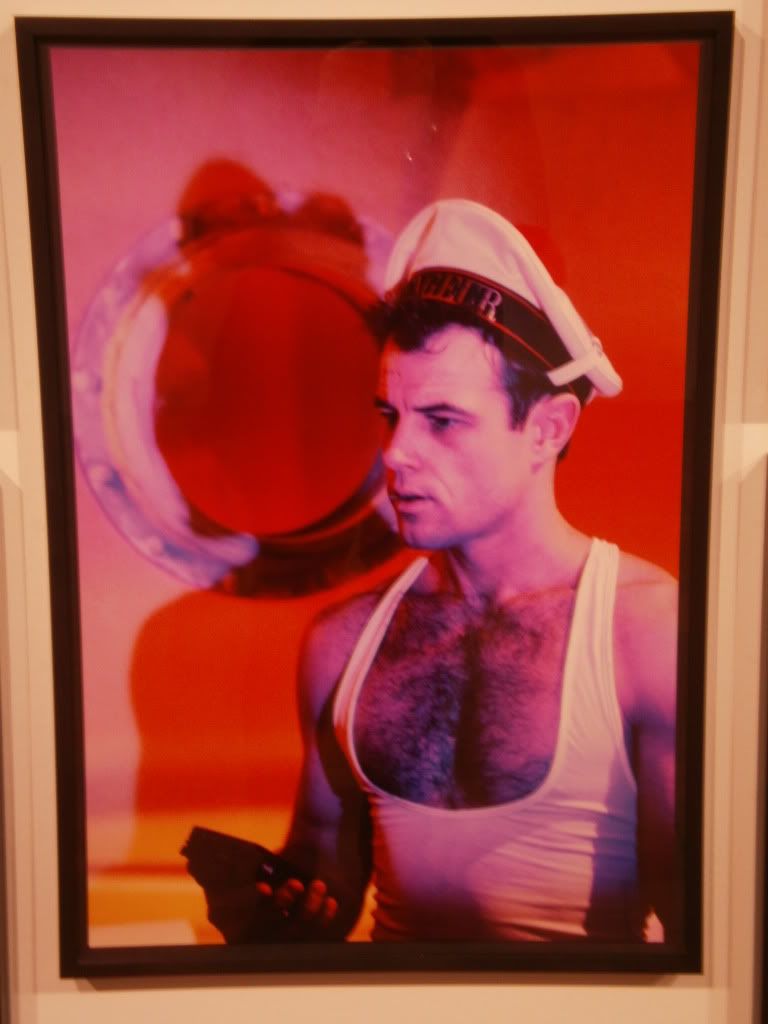
Sunday, 26 February 2012

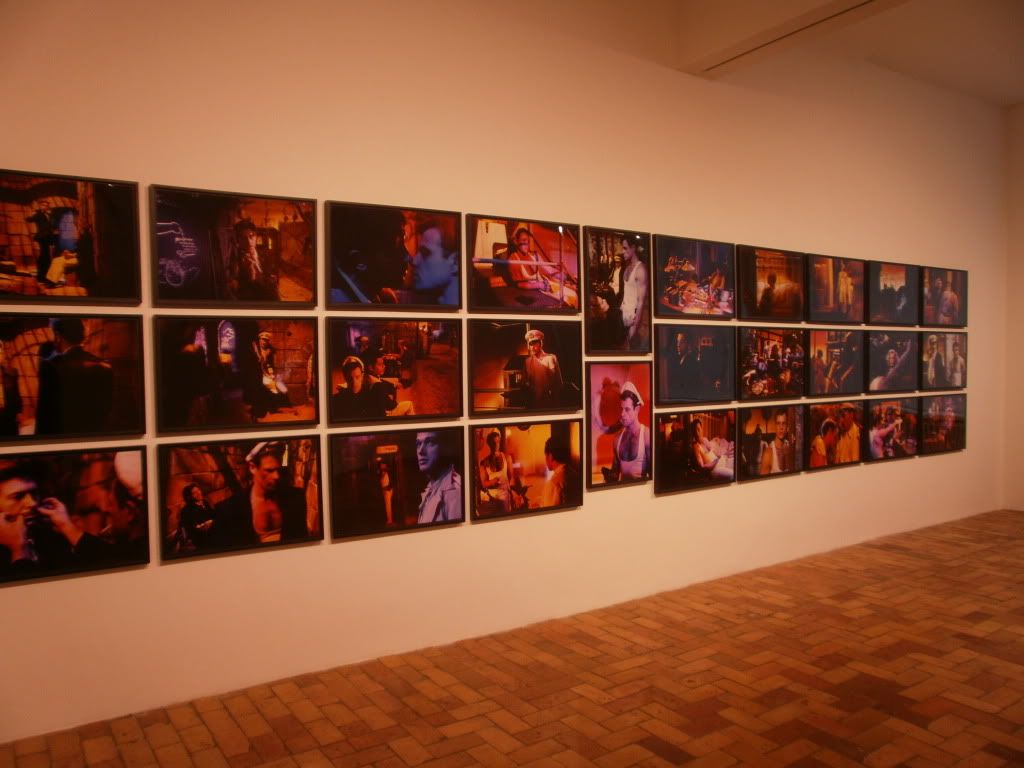
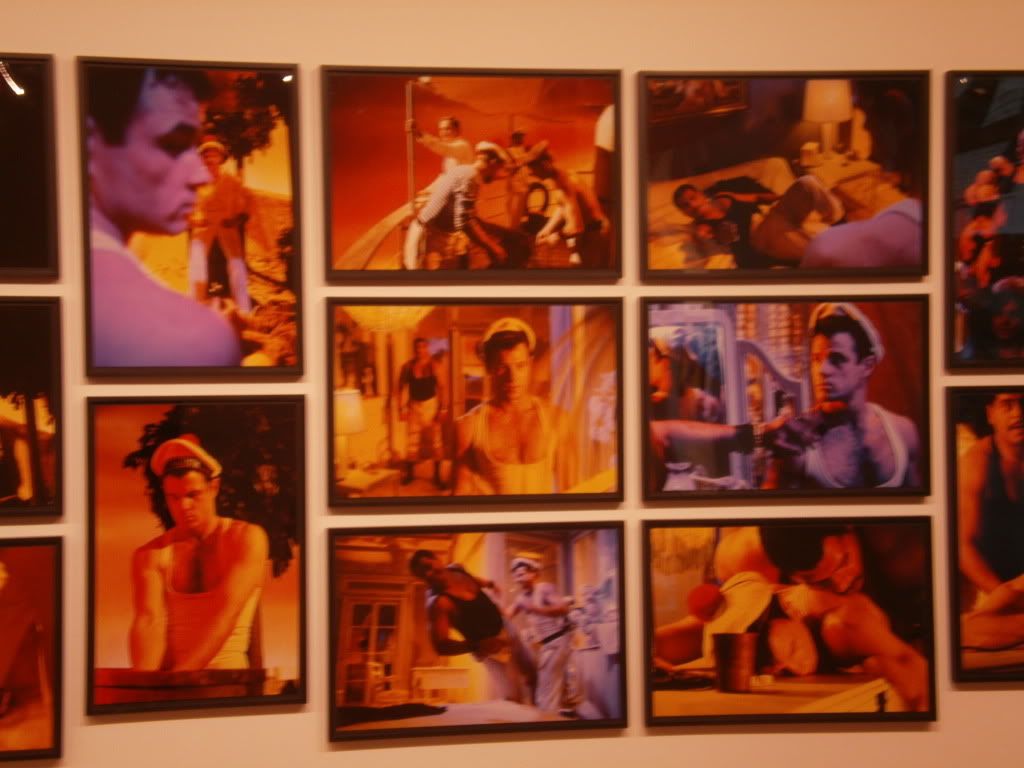
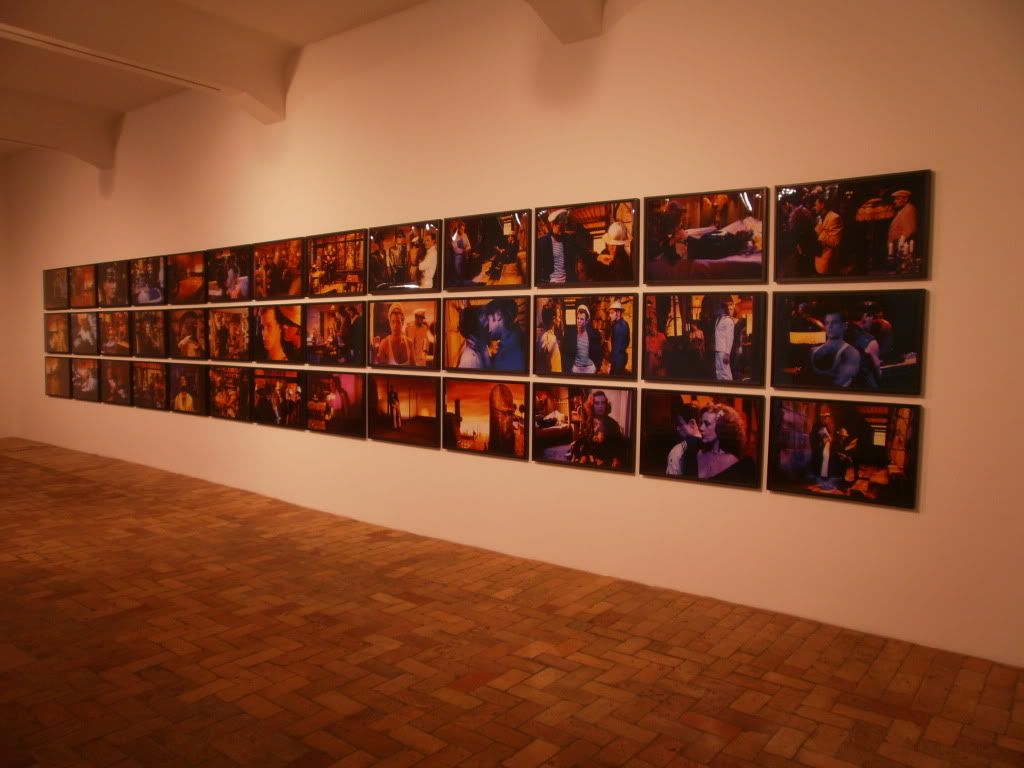
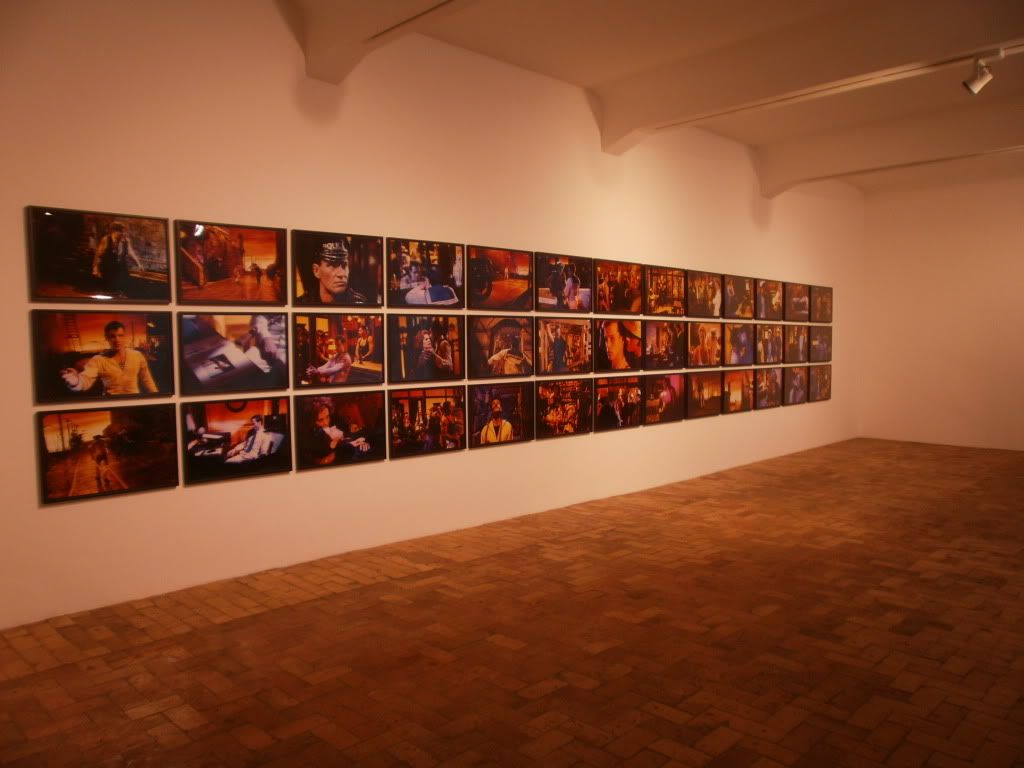
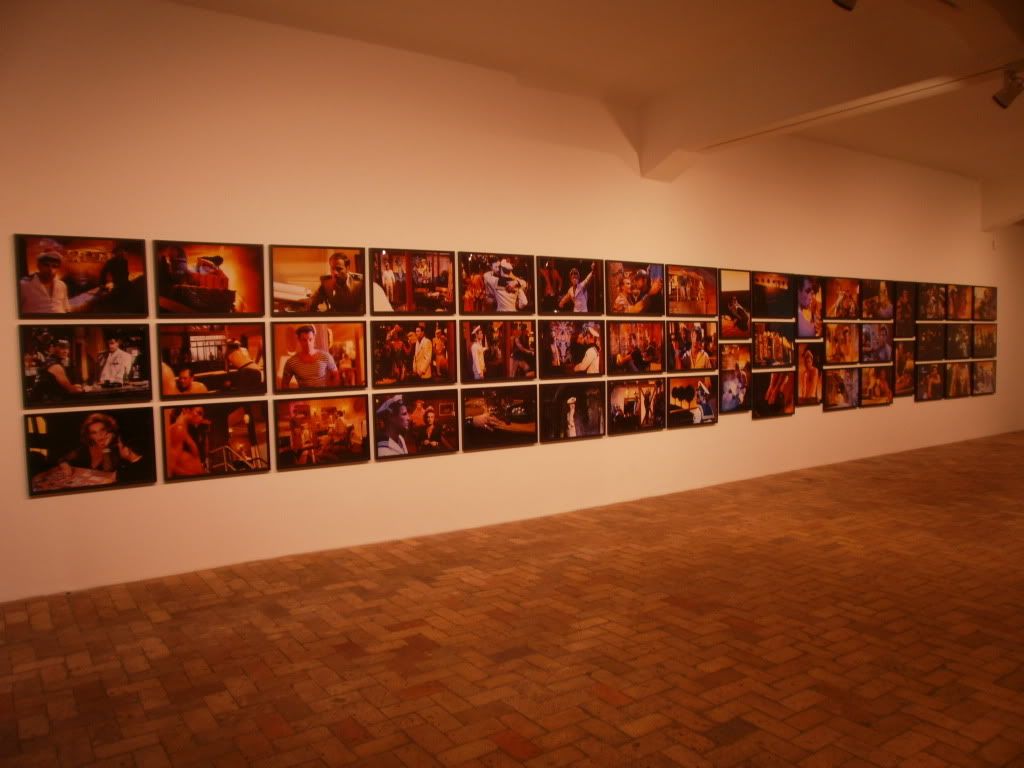
Querelle-Photographed by Roger Fritz (VeneKlasen Werner, Berlin)


My most recent visit to Berlin also tied in with the city hosting its annual film festival, which is always a bit of a bonus. Apparently, Angelina Jolie and Brad Pitt were in town, although our paths never crossed, just as I never bumped into Madonna, Joe Dallesandro and a host of others on previous coincidental sojourns. Maybe I'm going to the right places - well, possibly not with regard to the latter. Anyway, to get to the point, one highlight and probably tied in with The Berlinale was an exhibtion at the VeneKlasen Werner gallery (Rudi-Duschke-Strasse 26) of photographs taken on the set of Rainer Werner Fassbinder's cinematic adaptation of Jean Genet's novel "Querelle" which had been completed but remained unedited upon the director's untimely and sudden death in June 1982. Now, anyone familiar with myself or German Bite magazine will know that Fassbinder rates extremely highly in the pantheon so not calling in was never an option.


Well worth the visit it was, too, as along the very lengthy walls of the three galleries ranged an enormous number of colour drenched photographs, uniform in size, although not always in dimension, many offering stills from the film, so many that its narrative could probably be retraced quite comprehensively by anyone familar with it and who had the time to be bothered, these also being peppered with occasional images not so directly recognisable from the final product. Superb they are, every single one I'd have quite happily brought away and hung on one my own walls, instantly bringing to life Fassbinder's unique, dark, fantasy vision of Genet's Brest, where the young, attractive Querelle has arrived by ship with a stash of opium, thus entering into a corrupting environment of perpetually smouldering male sexuality (and a tiny bit of female, too, in the shape of Jean Moreau whose cock obsession more than matches the men's at times), duplicity and betrayal, whispered intrigue and murder, all this played out on a wholly studio constructed set, complete with a plethora of phallic imagery, including bell-ended quayside masonry and walls smattered with cottage-style drawings and messages - one piece which made me chuckle read "Kilroy was here" or some such; maybe you need to be British to appreciate the joke. All this is then fantastically filtered through saturated tangerine and pinky blue hues, the stylised, artificial splendour of which I can only, off the top of my head, find parallels with in some of Kenneth Anger's oeuvre or maybe "Pink Narcissus", certainly nothing before or since which has had  such far-reaching ambitions and a wide, international audience in mind.


To almost top it all off and for those with a bit of time on their hands, in an equally capacious fourth space - quite fittingly a dark room at the rear of the whole shebang - they had constructed a small cinema where the film in its entirety was showing daily at 1400h. My travelling companions and I, being lucky like that, arrived just in time to catch the majority of it, even though we'd all seen it loads of times before but still enjoying the opportunity to relive favourite and familair elements: the iconic (I hate this word) image of Brad Davis in his pompommed sailor's cap,  taut, scoop necked vest and matching white bell-bottoms; the game of dice he plays with man mountain bar owner Nono (played by Fassbinder stalwart Günther Kaufmann), the losing of which leads to him having to take it in the tradesman's as a "forfeit"; Jeanne Moreau at her finest, seemingly confined to the aforementioned smoked-glassed bar/brothel with its anachronistic space invader machines, singing lines from Oscar Wilde's "The Ballad of Reading Gaol" and reading her tarot cards, her final insight suggesting the whole film has been a figment of hers, somebody's, everybody's imagination; the very handsome, gentlemanly Franco Nero pacing around the decks of his ship, The Vengeur, privately recording his repressed attraction for the socially inferior Querelle into a tape recorder, whilst around him his queeny crew - including the late,great Frank Ripploh of "Taxi Zum Klo" fame, to keep the Berlin thread going - rather balletically pull on ropes or diagonal through the shot carrying out what look like pointlessly essential tasks; Hanno Pöshl in the dual roles of Querelle's brother Robert, with whom he shares an unstated sexual connection, and the helmetted, side-burned Gil with whom he identifies because he has similarly committed a murder and who he says he will help to escapefrom the clutches of the police, because he fancies him, but ends up betraying with a Judas kiss; and Burkhard Driest (who also co-wrote the screenplay with RWF) in the role of Mario, the pock-marked police officer who looks more like something out of an early eighties New York S&M bar like The Anvil than someone from down the local cop shop with his leather cap and waistcoat. All of this is beautifully coupled with Peer Raben's perfect soundtrack, his contribution nearly always being an essential ingredient of a good Fassbinder film in my book.

Even better, though, at 1600h daily, they were also showing the rarely screened feature length documentary "The Wizard of Babylon", directed by Fassbinder's producer Dieter Schidor and featuring a lot of footage filmed on the set of "Querelle", as well as insightful interviews shedding light on the working relationships on set, a seemingly contented or possibly diplomatic Ms. Moreau who says she was enjoyed the whole experience, Brad Davis who surprised me with his campy, primadonna-ish attention seeking and Burkhard Driest who holds back nothing in expressing his displeasure at the way he has been treated by the director. Perhaps most interestingly, it also includes footage from Fassbinder's last ever interview, filmed just hours before he breathed his last and, as he lights one cigarette after another and speaks in a slurred manner which suggests that the dying process may have already begun, some of his words seem spookily prophetic, as he admits to seeing parallels between himself and his protagonist who has made a pact with the devil - as we know, Fassbinder made forty-three films in not much over a decade so that one of his repertory, Peter Märtesheimer, I believe, once said, "he turned out movies like other people roll cigarettes." As is often the case, he died right on the cusp of major international fame, having received his first Golden Bear with "Veronika Voss" and enjoying the first tastes of having begun to break the American market, such as partying with the likes of Andy Warhol and Jackie Onassis, an imminent appearance of his fizzog on the cover of "Time" magazine and a developing chance of winning best director at the 1983 Oscars. I once read something where the writer drew parallels between Pasolini, who was murdered before "Salo" was premiered, and Fassbinder, the conclusion being that both directors had taken themselves to places of such intensity that careers beyond these points seem unimaginable. It's a very convincing argument.

Finally, by way of a souvenir, visitors could take away a little, almost pocket-sized booklet including a number of reproductions of photographs from the film and its set, as well as the rather fascinating facsimiles of correspondence dating back to 1978 between Dieter Schidor and other directors, Sam Peckinpah, John Schlesinger and Roman Polanski, which indicate that Fassbinder was in no way initially favoured for the role, even though I'd always thought that Genet's novel, along with Döblin’s "Berlin Alexanderplatz" and Fontane's "Effi Briest", represented a kind of holy trinity of texts which had obsessed him as a youngster and he saw himself as destined to adapt. The former very nearly took the bait, it appears, which would have made for a very different world, methinks.

Now, I was going to encourage anybody who reads this and is able to visit the exhibition to do so. However, I've just looked and seen that its rather short run finished yesterday which is a bit disappointing. Maybe it will crop up again somewhere else. If it does, I recommend it most highly. I got an awful lot out of my visit, including a desire to dust down a couple of my Genet novels.

Saturday, 25 February 2012

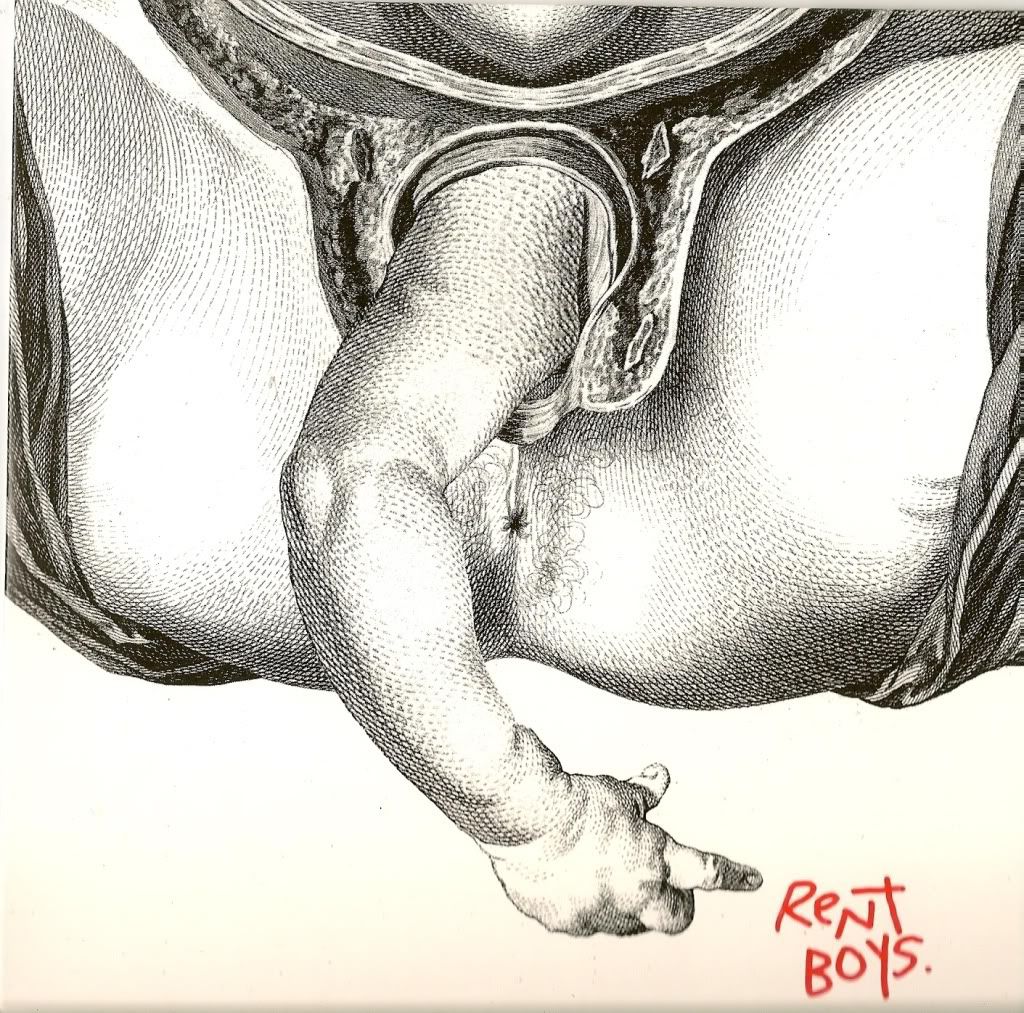
German Bite Records: BISS01 / Rent Boys-Shoot Your Shot / I Think... (7" Single)

Germanbitelogo2.jpg image by germanbite

I've absolutely loved Leeds' Rent Boys since I very first saw them at one of their earliest gigs a couple of years or so ago, upstairs one night at The Cockpit in said city where, in front of a small gathering of friends and the occasional stray,  they blasted through an already accomplished set - this was only their second gig, I think -  with such absorbing energy  as I'd not experienced for a very long time, if ever, perhaps. Although the music was clearly punk, garage, trash, whatever you want to call it, inspired, it was clear that Rent Boys already had an ambition and intelligence which was going to transcend such labelling from their very outset. Although they sounded on the one hand fresh, spontaneous, absorbing and vital, it was also obvious that a good deal of thought had been given in advance as to how theirs was going to be a more textured, treated and developed sound than many of the bands with whom they've since played or with whom I've heard people try to compare them or pin on them as influences. I've seen their sound described in writing as "sexy sick garage noise" and "glam goth", both of which I like as they do capture a good proportion of what Rent Boys are about, but there's also something else there, something more experimental which goes beyond the confines of their conventional vocals, guitars, bass and drums line-up, something more extreme so that live I often forget they're a guitar band, as the overall effect can feel as though they're using pure electronics with the same intensity as certain Throbbing Gristle tracks, for example, whilst also bringing to mind people like The Birthday Party and early Jesus and Mary Chain much more so than US-style punkers or those of a more earnest bent who seem to be the flavour of the day en ce moment.

Quite a number of subsequent gigs have followed the one mentioned above, including at least two visits to Berlin where they've always gone down well, trips over The Pennines to Manchester and, more recently, Liverpool which has seen their northern audience grow apace, a recent nine date tour of France which got all the right Gallic tongues wagging, I believe, and several successful trips down to London, including an early gig at The Horrors' Cave Club in July 2010 and a more recent performance involving a bed, I was told, at home of the hipsters Glam Racket, all of which keep the invitations down to the capital rolling in. Plus, of course, they regularly turn out for the home crowd, the same faces and a few more appearing at every gig, as Rent Boys shows are always worth braving the cold for, not just for the music, but the whole event itself where these growing exhibitonists, who have a strong appreciation of the absurd and a lack of fear of being in touch with their feminine sides, put every effort into making each performance a memorable assault on all of the senses, most gigs being a kind of post-punk, idiotic gesamtkunstwek, if we want to get a little Wagnerian about it, but oh-so effective, affective and addictive, too. After a period of gigs at which monster-sized, polystyrene ball filled soft toys were thrown around like missiles through the shards of stroboscopic light which cut through the dry ice - said stuffing would then rain down copiously, leading to a room full of ruined drinks and a rather big cleaning up job for somebody at the end of the night - Rent Boys seem keen to take their shows in another direction now, whilst retaining the intensity and unpredictabiltiy of those that have gone before. Last Saturday at Santiago's in Leeds was no exception as, just before they launched into their first number, a sheet separating the audience from the all white, ultra-violet lit and dry ice enfused room in which they played was torn down to allow access to the band who, dressed all in white, heads covered, faces painted and wearing white sunglasses, appeared like a mad scientists, angels performing in the afterlife hybrid. The television studio from the original version of "Charlie and the Chocolate Factory" sprung to mind, too, somewhat. Somebody - was it the little Japanese art student, I wonder - managed to film it quite successfully, somewhat of an achievement amongst all of the chaos, although unsurprisingly some of the sound quality has been lost. My ears were ringing while Wednesday, as we say in Yorkshire. Here they are that night doing their debut single "Gang Love" which came out about a year ago on Sex is Disgusting Records, followed by a new, more melodic number interestingly called "Sod".


So, following two blisteringly pounding singles on other labels, - the aformentioned "Gang Love" and the more recent "XXX Communicate"(Death Pop) - conversations which probably stem back to that early gig in autumn 2009 and a little delay in production, German Bite Records is proud to launch iself with a new 7" single, "Shoot Your Shot". No, it's not a cover of the Divine classic, although it does share some of the same seedy aesthetic and a desire to heave people out of their seats and up to dance, but rather a record which is bound to delight those already familiar with the Rent Boys experience, albeit one that develops with each new release and performance, whilst no doubt bringing on board new recruits. Stingingly abrasive, whilst possessed of a wry intent to entertain, the single blasts out of the speakers like a nuclear spring-cleaning device, guaranteed to purge the room and its listener in just two and a half minutes. Flip it over and change the speed down to thirty three and a third rpm and a much more spacious, dubbed out, trippy and diabolic Rent Boys can be heard on "I think...", one that brings to mind The Pop Group more than Die Electric Eels, whilst sounding nothing like either, and suggesting a band as eager to evolve and confound as they are to simply thrill and amuse.


Already possessed of a record buying public extending across the Atlantic, throughout Europe and over to Japan, “Shoot Your Shot”, limited to 500 copies on 7” only and each containing a unique, handmade insert, is guaranteed to continue to delight the discerning listener. Get yours now whilst stocks last. Why not be completist and try to collect all five hundred?

I'll keep updating this post with details of stockists but, in the meantime, if anybody wants a copy, let me know and I'm sure I can get one to you for £4 plus whatever postage and packaging works out to where you live. You'll have to be able to pay me by Paypal, I guess.

Here's the video they made for the single. It reminds me a little of The Bachelor Pad who were one of my very favourite bands of yesteryear.


Finally, before I go, I should mention that, unlike last time they played at Santiago's in September 2010 when the amazing Val Denham did the honours, Rent Boys were supported by Sniffs who are coming along extremely nicely, augmented by a new, handmade and extremely powerful oscillator, which looks like a landmine, and a couple of new tracks aired for the first time. Fingers crossed for BISS02 sometime later this year.

Copies are now available in Jumbo Records in Leeds and from Norman Records Mail Order. I've just sent some to Piccadilly Records in Manchester, too, so they should be out on the racks, too.

Wednesday, 16 November 2011

We Can Be Heroes


Another final highlight of my recent trip to Berlin was meeting and becoming friends with fashion designer and ex-Blitz Kid Judith Frankland who was the house guest of a friend of mine whilst she looked for her new flat in Neukolln to where she has now relocated. When I went round there, she was sitting at the table with a Berliner Pils and we had a right old time. Anyway, amongst practising our Polari on one another and covering conversational topics such as the brilliance that was Billy Mackenzie, how much we both rate the most recent Depeche Mode 3CD remix set, our mutual friend Julia Fodor and how massively underated are the band Blancmange, she told me about a fantastic sounding new book due out very soon, "We Can Be Heroes".

Basically, it's a collection of photographs taken by Graham Smith who was part of the late seventies/early eighties London club scene and comes with text by Chris Sullivan, Robert Elms, Boy George and Steve Strange, as well as "500 pithy quotes from more than fifty of the main faces on the scene." It sounds very much like it will make quite a nice companion to go with Stephen Colegrave and Chris Sullivan's "Punk" book of a few years ago and not altogether in a different vein.

It's one of those books where it only gets published when a sufficient number of people subscribe and, thankfully, they've just met their target in the last twenty-four hours or so. However, you can still get in there to get an initial copy by the looks of things and depending on what you're prepared to pay you can get various packages which could include an invitation to the launch party or even some limited edition signed prints of the images, should you so wish.

Here's the link and a couple of videos:


Sunday, 13 November 2011

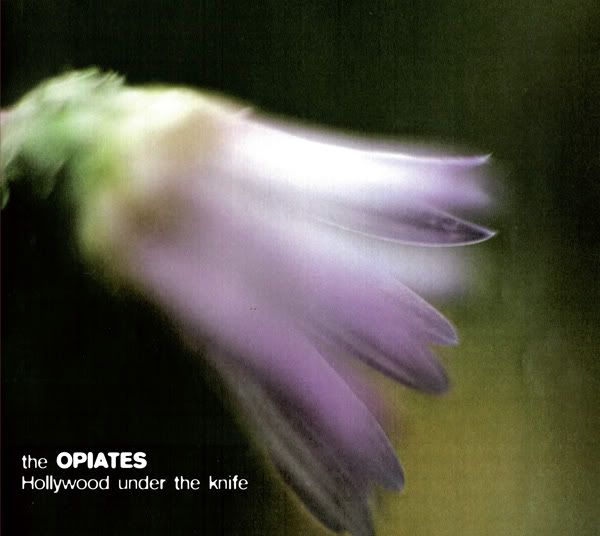
The Opiates-Kantine am Berghain, Berlin: 26th October 2011 & "Hollywood Under The Knife"

Billie Ray Martin is somebody who never fails to fascinate and who, over the last twenty years or more, has kept reappearing with one project or release after another of invariably high quality and impeccable style. Whether it be her clutch of hits with Electribe 101 which blended a sophisticated electropop with Chicago house beats as the 1980s morphed into the nineties, her powerful dancefloor cover of Throbbing Gristle's "Persuasion" which she produced with Spooky in 1993 (The Chameleon Mix is simply amazing), her monster worldwide hit of 1995 "Your Loving Arms", the 2003 Hot Skates 3000 single "No Brakes on My Rollerskates" (This time the stand out mix is by S-Express man Mark Moore), her "Dead Again" 12" of the same year, "Je Regrette Everything" the track on which she collaborated with DJ Hell in 2005, last year's "Sweet Suburban Disco" single with a brilliant remix by good old Vince Clarke or her more recent reworkings of Cabaret Voltaire's "The Crackdown" and "Just Fascination", anything she releases is guaranteed to be worth sitting up and taking maximum notice of, all combining her richly soulful voice and thoughtfully sequenced electronics which often point cleary towards the dancefloor, albeit somewhat more subtly in some cases more than others. It's no wonder she's been dubbed somewhere as "The Queen of Electronic Soul".

The Opiates, one of her most recent projects, on which she collaborates with the Norwegian musician Robert Soihem, is no exception either and is probably, in my opinion anyway, one of the very best things she's ever done and that's coming up against some pretty stiff competition. They first appeared about three years ago with a four track 10" EP titled "Anatomy of a Plastic Girl" after its lead track and which featured the addictively danceable "Candy Coated Crime" which first drew me in and, like so much of what she does, I presumed after all this time that it had been yet another one-off collaboration in her ever expanding canon. But no: they're back with a new EP, "Rainy Days and Remixes", featuring "Anatomy of a Plastic Girl" remixed by Chris and Cosey, and a full album "Hollywod Under The Knife" which is phenomenal from start to finish. It's barely been out of my player over the last two weeks, doing battle for prime position with the fantastic S.C.U.M. album which can't be praised enough either. Recorded in her city of origin, Hamburg - I wonder if she knows three of my other favourites: Andreas Dorau, Holger Hiller and Felix Kubin.Wouldn't it just be lovely if they were all friends? - and coming accompanied by a sleeve and booklet featuring photographs by swishy Turner Prize winning photographer Wolfgang Tillmans, the nine tracks (plus an extra, gloriously elongated version of "Candy  Coated Crime") are shining examples of why many people have come to love her, beguiling lyrics populated by a series of isolated, introspective, deluded or downright mad personas and characters over bubbling, pulsing electronics, all this combining, in places quite cinematically, to create gorgeously evocative atmospheres and moods.


On one track "Silent Comes The Night Time", the urban heat is so tangible that one can practically feel it wafting in through the gap in the curtains from the darkness outside and on another "Rainy Days and Saturdays" the feeling of gloomy ennui, the result of an empty day spent alone with no company but self-analysis, is horribly infectious. Elsewhere "Reality TV" is an absolute gem, too, its poppiness and unashamedly brash, astringent synthiness making it sound like the fifth single Yazoo should have but never did release and "Oprah's Book of the Month Club (Part Two)", "Jalousies and Jealousies" and "Anatomy of a Plastic Girl", as is the case with the track just mentioned, weave tales of  rather unsuccessful, hollow celebrity aspirations, as is belied by the album's title and also somewhat obliquely reflected in Tillmann's accompanying images. It's a total masterpiece, albeit one that looks likely to be almost totally overlooked.

When I was in Berlin a couple of weeks ago, I was delighted to see that they (she) were performing as part of the "Kometenmelodie" club night at The Kantine am Berghain. So, armed with tickets we'd picked up the day before, myself and a companion walked rather confusedly through the pitch blackness of a Friedrichshain night, towards a rather desolate seeming dead-end where we then followed a series of dimly flickering lights across some scrubland, a bit like a secret trail laid out for those willing to put a bit of effort into their initiation, until we reached the quite busy venue hidden in what seemed like an unpopulated rather dead, industrial landscape.


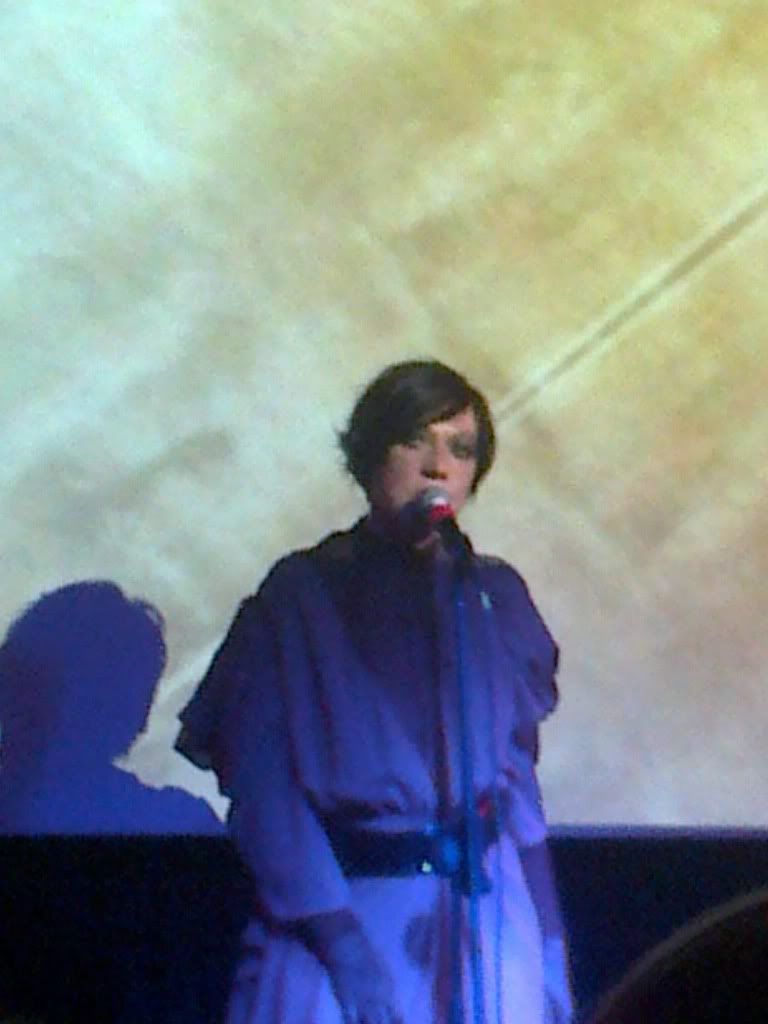
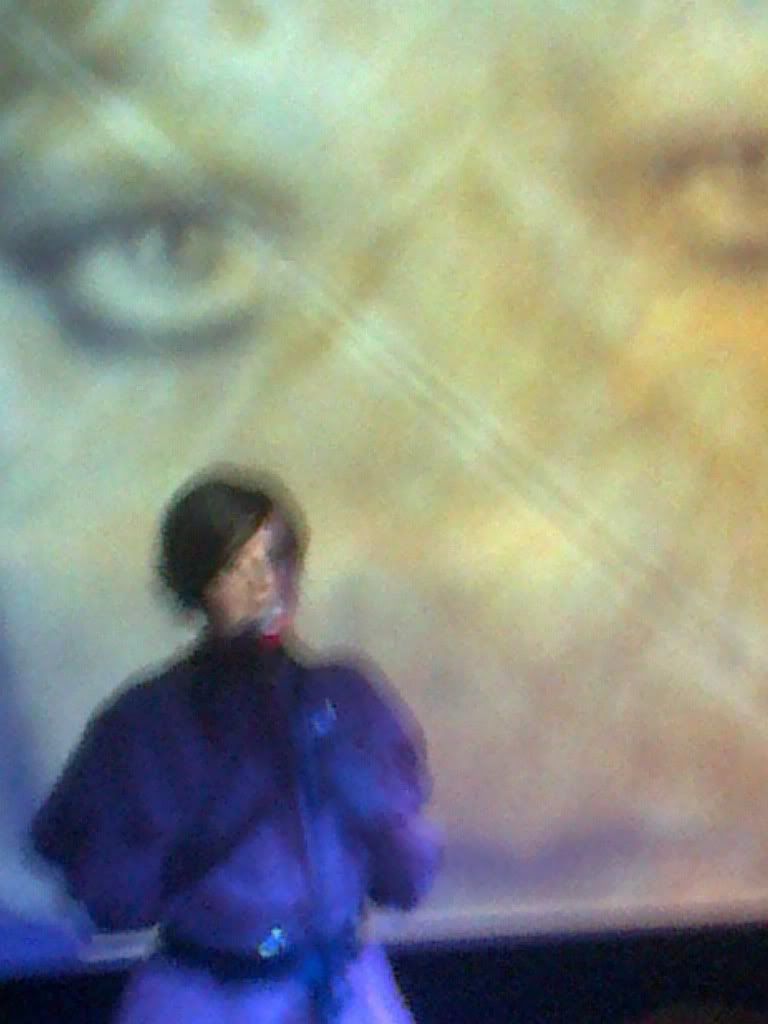
When she first arrived on the quite dimly stage, illuminated mainly by film projections which towered above her, and kicked off procedings with the aforementioned "Reality TV", which also served as one of the encores, too, she had quite long curly hair which came as quite a surprise as I tried to work out when she'd had the time to grow it since I last saw a photograph of her. However, as song number two, "I'm Not Simone Choule", unfolded, accompanied by scenes from Roman Polanski's 1976 film "The Tenant", things became a bit clearer. I'd not previously twigged when I got the 10" single but Simone Choule is the previous inhabitant of Polanski's character's apartment and the person who he slowly becomes in his mind, the wig Ms. Martin was wearing picking up on his transformation and the whole theme of personas which runs through the album, as well as looking a little like the curly mop sported by Isabelle Adjani in the film, although in her case accessorised with googly Sunnie Mann style glasses, as she appeared on the video sceen applauding and encouraging Monsieur Trelkovsky/Mademoiselle Choule as he jumped not once but twice from his high up tenament window onto the glass canopy and hard courtyard below.

Then, off came the wig in the very best Fuggerstrasse tradition - she didn't smudge her lipstick up her cheek, though - and a more recognisable Bille Ray Martin, having called up to the stage anyone else in the room wearing  a wig, completed the set with a much more familiar appearance. Flanked on the right-hand side by Roi Robertson of Mechanical Cabaret, who was providing the musical accompaniment in the absence of Mr.Soihem with the aid of a laptop and a rather covetable little Jen synthesizer, she then worked her way through practically every track on the album, all accompanied by very effective short films, one specially for each track, until the climax in the form of a stunningly long version of "Candy Coated Crime" which morphed temporarily into Donna Summer's "I Feel Love" at one point, our heroine rising more than admirably to the challenge. My companion was beside himself as, in fact, probably was I. It was extremely good. Here's a couple more pictures of her and a couple of clips filmed a few days earlier at London's Bear Pit, which sounds a brilliant place, and the HMV Store on Oxford Street.

TheOpiatesBerlin2610112.jpg


Nico, Jacno, Divine & Sleazy


Tuesday, 1 November 2011

Andreas Dorau: Hau 2, Berlin - 29th October 2011


Regular readers of this blog will have seen me mention Andreas Dorau on a couple of occasions previously and most noticeably when his latest album "Todesmelodien" was released early in the summer and I posted a rather rushed review with some initial thoughts. They'll also be familiar with the fact that he's someone I think is wonderful and whose career I've followed quite closely for the last couple of decades and more besides. My excitement, then, when I saw that he was playing in Berlin on a Saturday night will come as no surprise. Given that the chances of him ever coming to perform in Britain are so slim as to be practically none, I got straight on the blower to the box office of the Hau 2 theatre in Kreuzberg to bag myself some tickets and then the Lufthansa website to organise some travel.

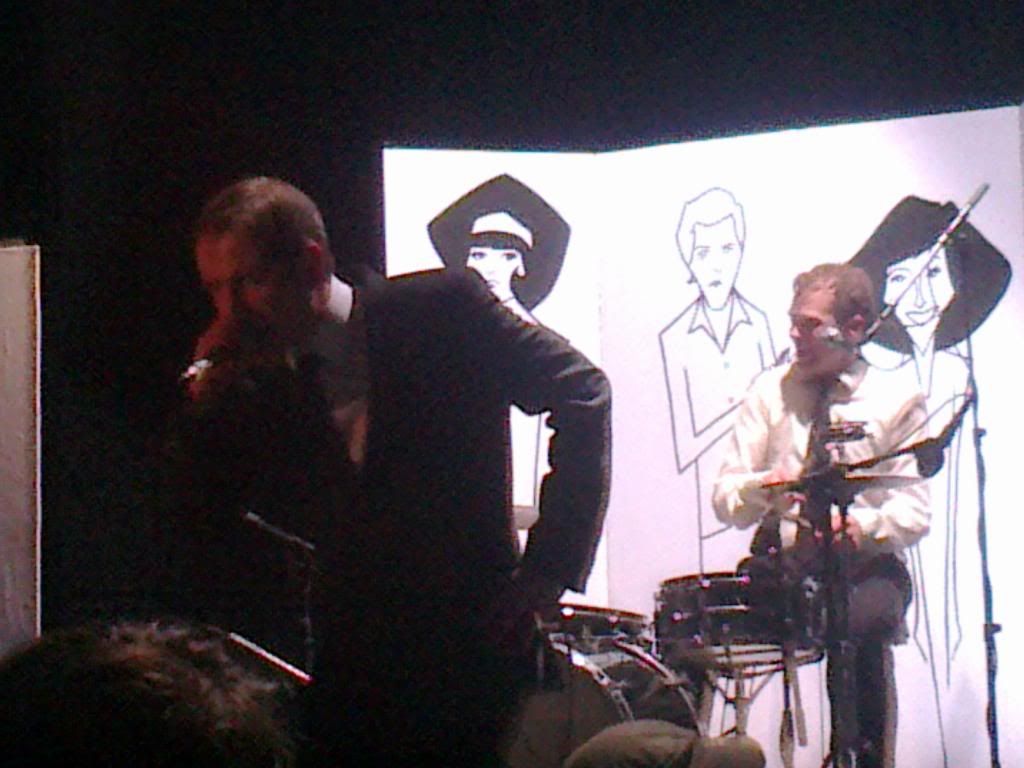
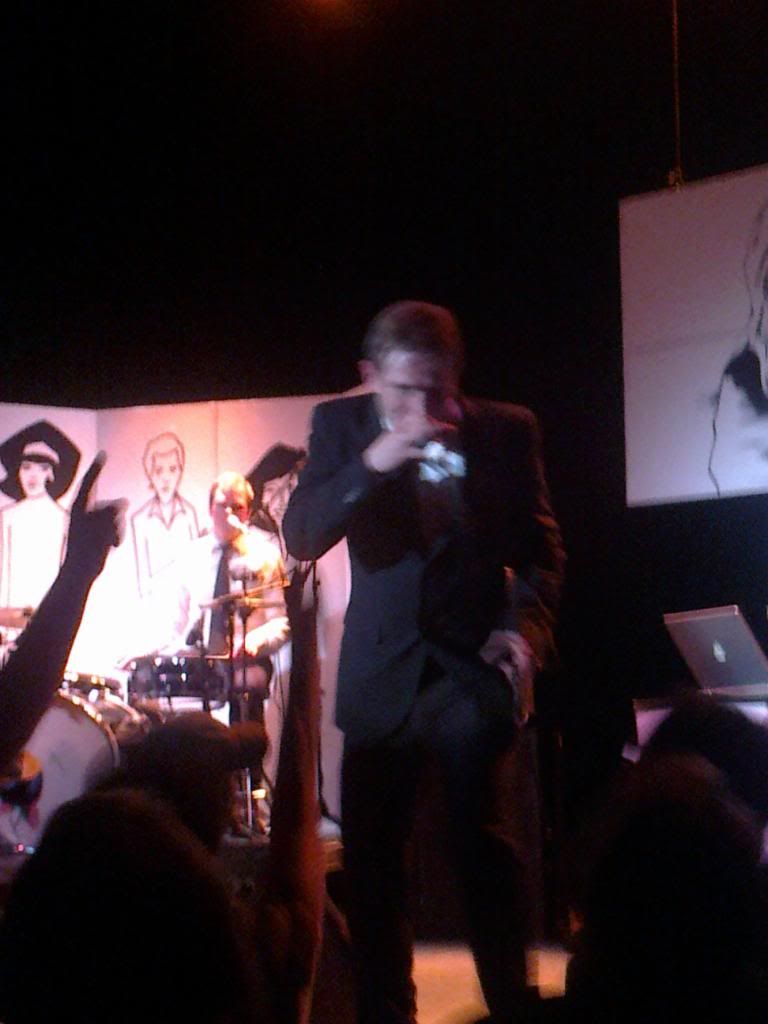
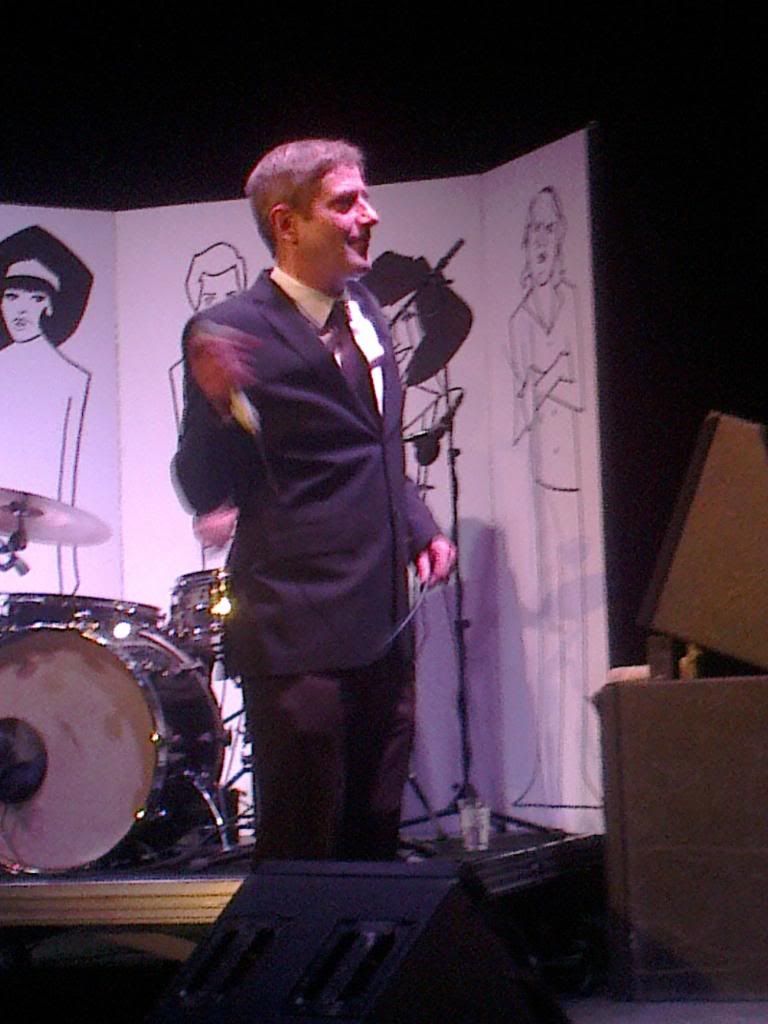
It was worth every penny, too, as he was absolutely astounding, much better than I could ever have dreamt. Dressed in a dark suit with black tie, funeral attire to pick up the death melodies theme of the album, this outfit also being worn by the jolly drummer and laptop maestro who accompanied him, he was like a hyper enthusiastic dynamo as he danced energetically around the stage, a bit like someone's uncle or best man at a wedding reception, delivering slightly manic renditions of favourites old and new.

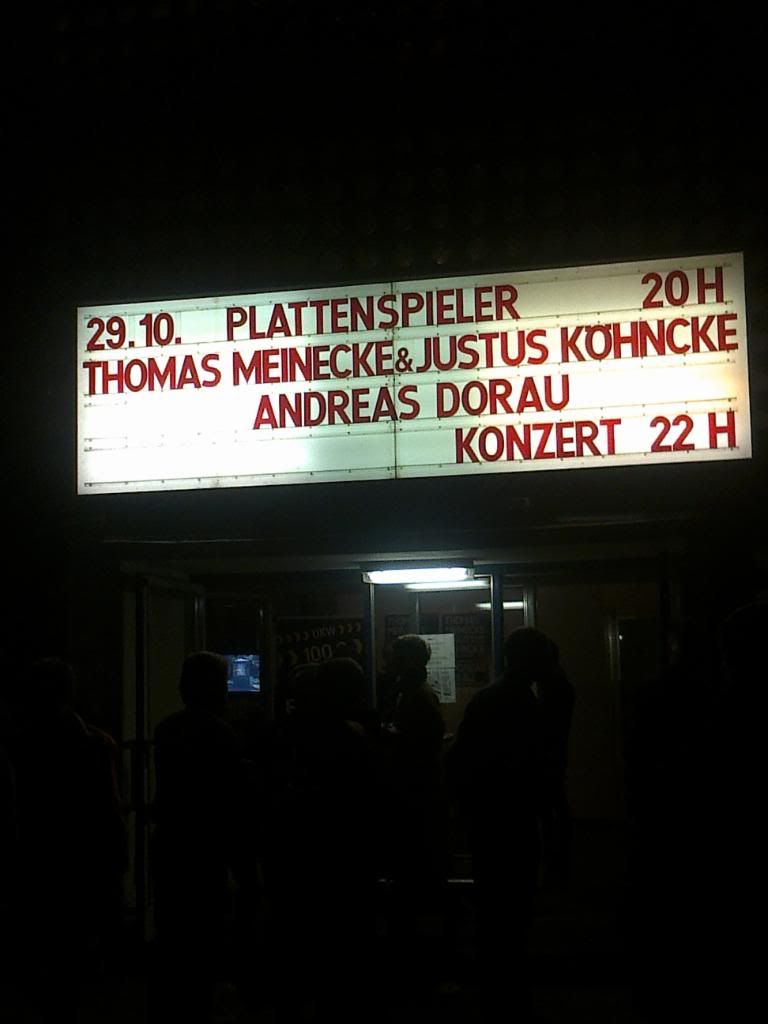
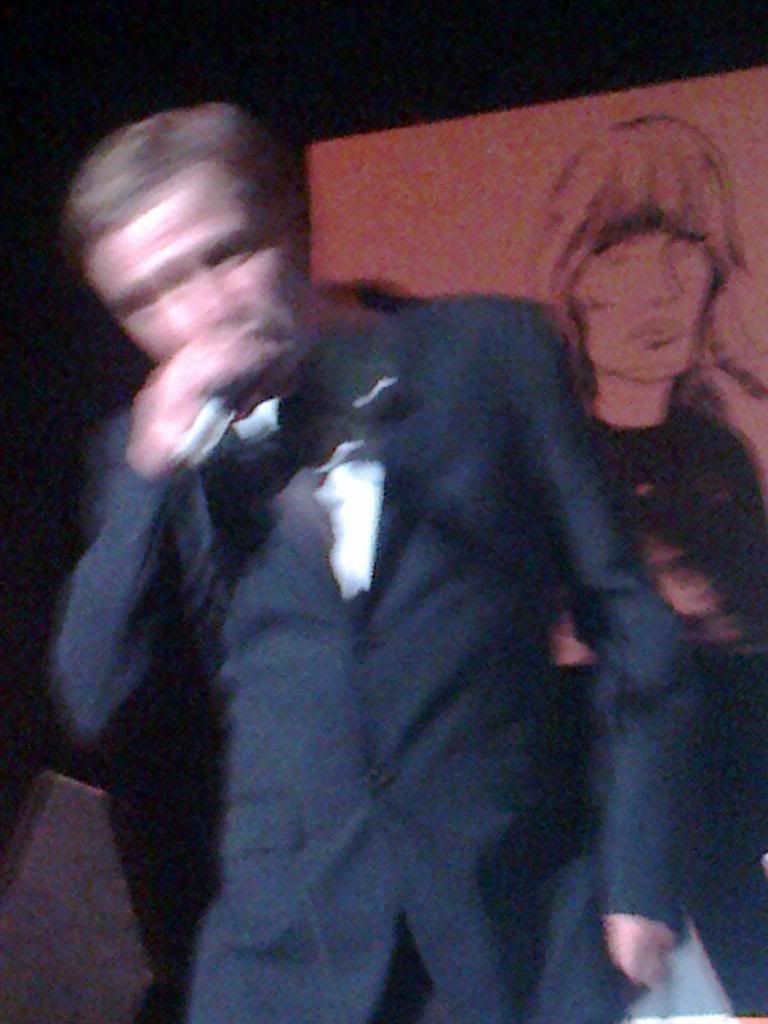
There had been an event on prior to the performance, "Plattenspieler", where his mate Justus Köhncke and Thomas Meinecke had been playing some of their favourite tunes to what looked like quite a packed house. When I peeped round the door they were playing Burt Bacharach's "What The World Needs Now Is Love" with the cover of "Portrait in Music" projected on a large screen above the DJ decks. As this overan slightly, it was about twenty minutes past the advertised time of 2200h when a new set of people and a dog - I kid you not; it lay on the floor and watched the show as its owner danced circles around it - entered the hall and within five minutes Herr Dorau and band were on the stage and launching into a version of "Inkonsequent" which must have been approaching double the speed that it is on the album, at least it seemed that way, maybe I was over excited like almost everybody else in the room by the looks of things, Wolfgang Müller's lyrics being delivered much more forcefully and boisterously than in their recorded context. And this set the tone for the bulk of the next hour and a half or so as he followed this with an amazingly lively rendition of one of the highlights of "Todesmelodien",  the electro disco "Und Dann", which almost raised the roof only minutes into the set, the scene resembling and sounding like a crazed acid house happening. Down near the front people were going completely crazy, the manicness of their dancing something I've not seen for a very long time and this only escalated when track number three, an old "hit" "Das Telephon Sagt Du" from 1994's "Neu" album kicked in. Meanwhile, the centre of attention bopped and marched around the front of the stage, all this achieved through the help of a long microphone lead, as he leaned over close towards his audience, first at one side of the stage, then the middle, then the other, practically rasping out the words and letting out cheers of encouragement in a manner which clearly betrayed his post-punk origins and the pleasure he was deriving from playing to such an enthusiastic crowd. He moved so quickly, in fact, only the flickering strobes slowing him down, that it was almost impossible to capture a picture of him that wasn't blurred and here's some evidence.

      AndreasDorauBerlin29101115.jpg     

The rest of the set then comprised most of the livelier moments of the most recent album, highlights being the two lead tracks - I guess they would have been singles in more innocent and better times - "Größenwahn" and "Stimmen in der Nacht", and these were accompanied by "Es War Hell" and "Gehen (Baby Baby)" the second of which had his German fans singing along with such joyous abandon that's rarely seen these days. He's clearly a bit of a hero to quite a lot of people other than moi which begs the question why he hasn't had more mainstream commerical success aside from his 1981 Die Doraus und Die Marinas hit "Fred Vom Jupiter" and 1997's "Girls in Love" which I believe made the top ten in France. This latter track was also included and although partly delivered almost acapella when a lead from the laptops stopped working temporarily it barely mattered as everybody in the room knew how to fill in the gaps admirably. "So Ist Das Nun Mal" from this album also featured favourably, too, as did "40 Frauen" and "Im September" from 2005's "Ich Bin Der Eine Von Uns Beiden". Then, after two encoures, the final song, a surprise in the form of "Nordsee" from his debut "Blumen Und Narzissen" album, perhaps a clue that he was about to disappear back to Hamburg, was performed, the drummer who had looked like he had been having the time of his life swapping his sticks for an acoustic guitar for the finale. It was absolutely fantastic and he must have been completely exhausted by the end of it - I'm feeling a little fatigued just reliving it. It's no wonder he had to disappear at one point for a few minutes, leaving the rest of the band on stage whilst he presumably nipped to the toilet or for some refreshment.

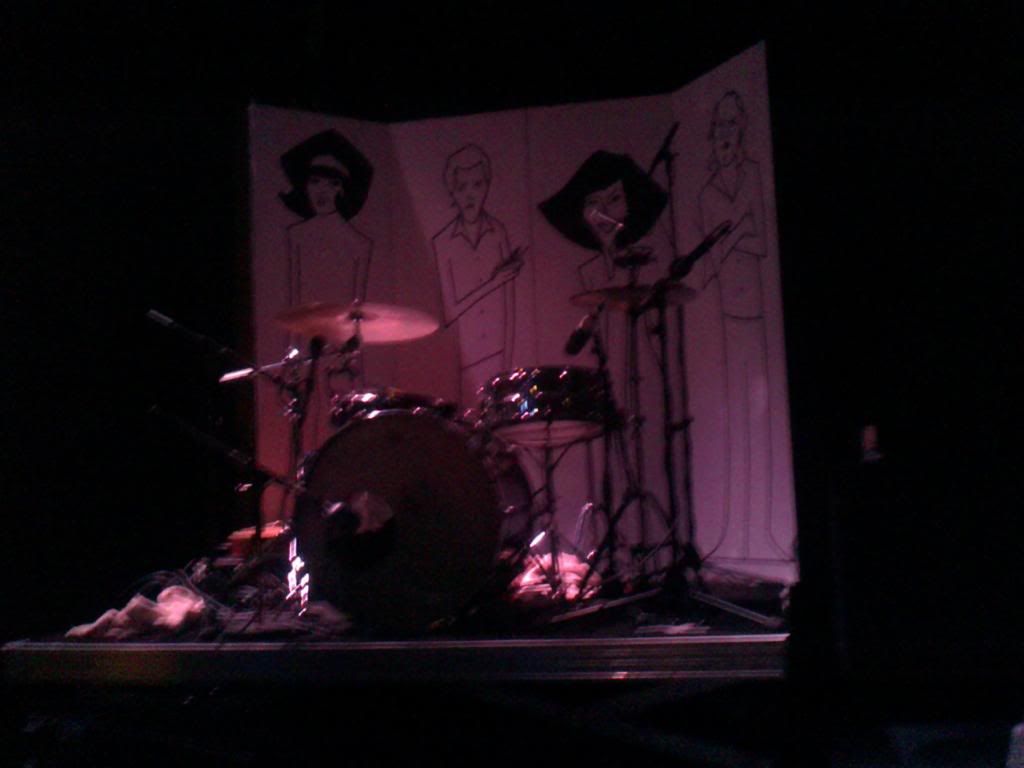
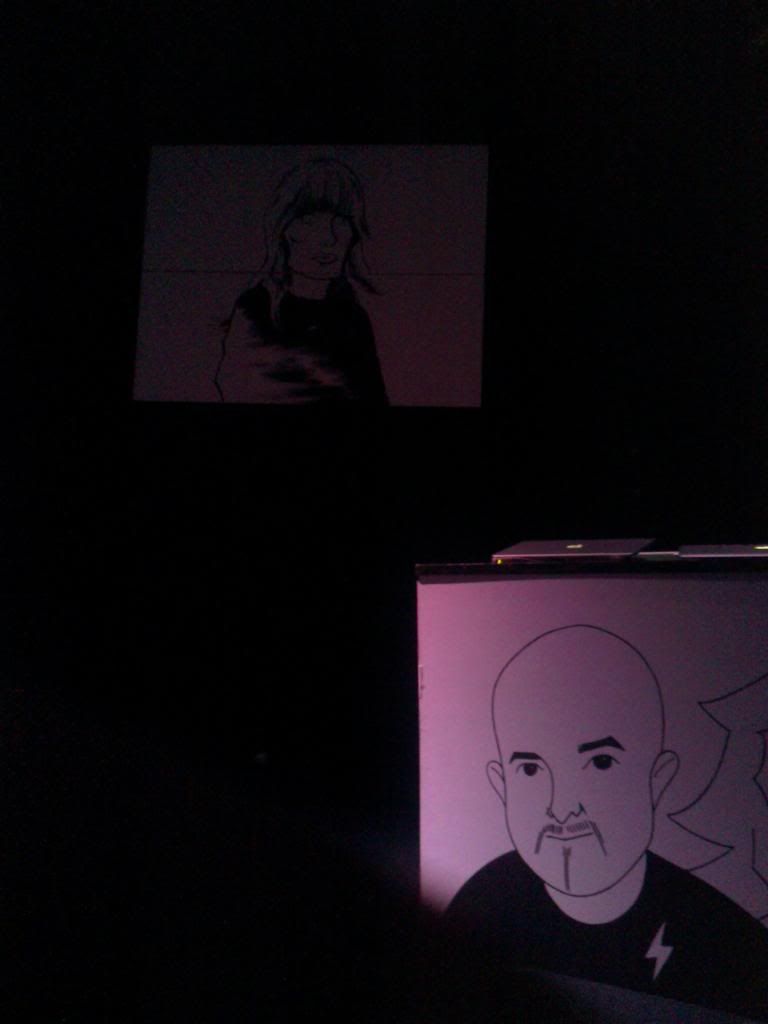
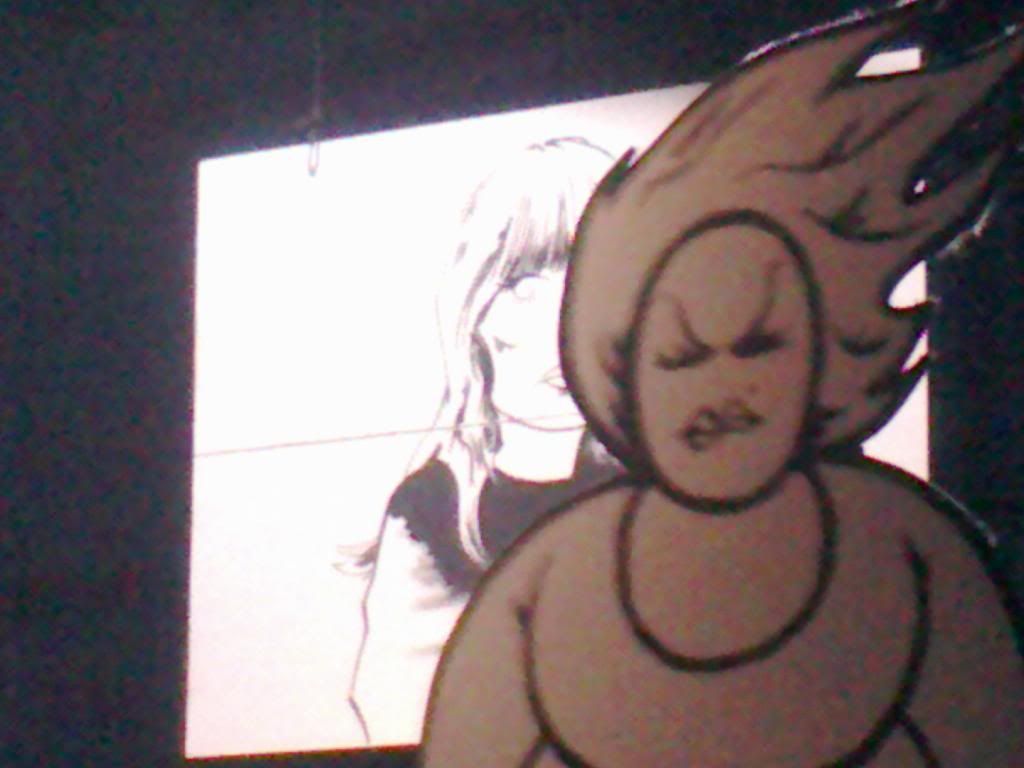
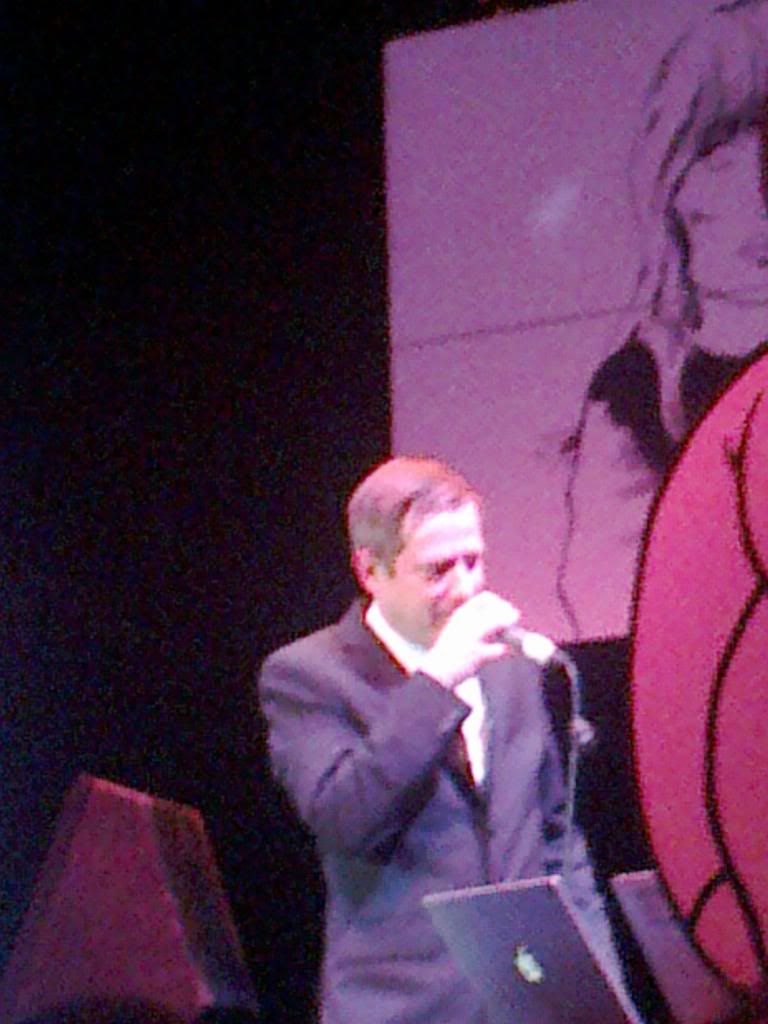
Finally, I must make reference to the stage dressing, too, which consisted of a panelled screen behind the drummer, a banner in front of the table on which the laptops lay, a large canvas suspended from the ceiling and a large cutout in the foreground, all decorated with cartoon paintings of dead musical heroes, again picking up on the idea of "Todesmelodien". At one juncture he tested the audience's knowledge of who they depicted, affirming and/or correcting their suggestions: Karlheinz Stockhausen; John Cage; Nico ("oder Christa Päffgen"), Jacno ("aus Elli und Jacno oder Stinky Toys"), Divine and Peter Christopherson ("aus die Gruppe Throbbing Gristle") featuring amongst them. It all makes such complete sense; four of these feature quite highly in my pantheon, too.


Andreas Dorau - what a brilliant man and what a brilliant concert, one of the highlights of my year, if not my life, if I want to get a bit over the top, which I think I might well do, actually.